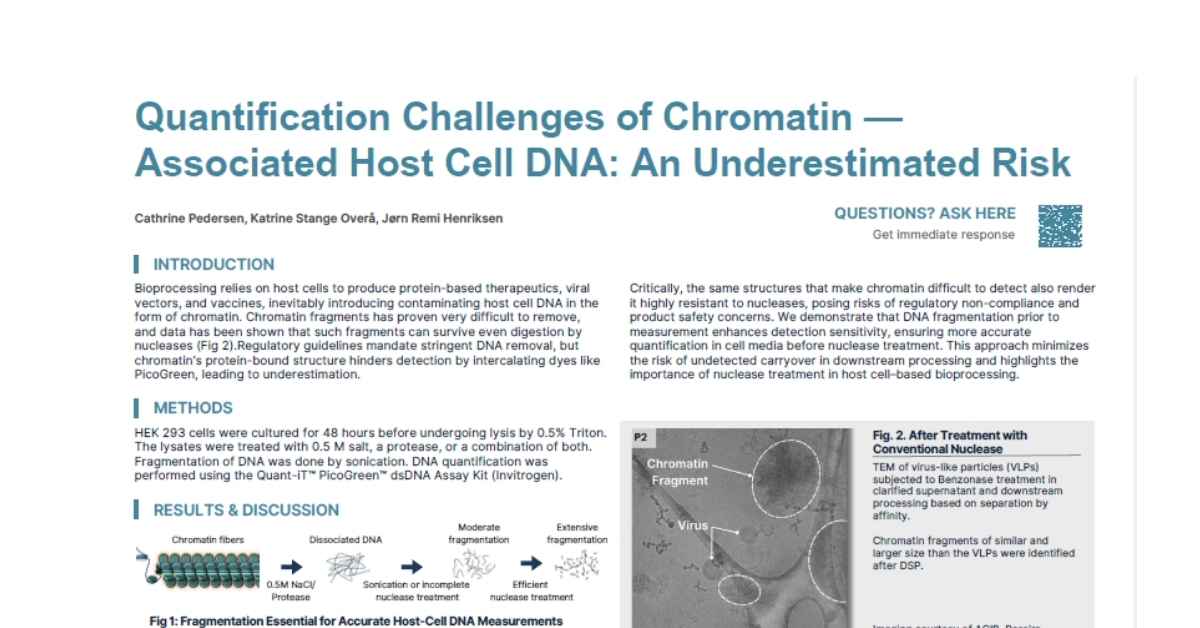
Developed by researchers at the Austrian Centre of Industrial Biotechnology (ACIB), this scientific poster explores how chromatin removal impacts virus-like particle (VLP) purification and downstream processing performance. Using an HIV-1 Gag VLP model, the study compares conventional nuclease treatment with salt-active nucleases and examines the effect on host-cell DNA removal, product purity, and chromatography efficiency.
What you'll learn
- Why chromatin is difficult to remove during VLP and viral vector downstream processing.
- How salt-active nucleases improve chromatin degradation compared to conventional nucleases.
- The impact of nuclease treatment on host-cell DNA clearance and final product purity.
- Why the timing of nuclease treatment influences downstream process performance.
- How ACIB researchers demonstrated a 5-fold increase in heparin affinity chromatography capacity when M‑SAN HQ treatment was performed before flow-through chromatography.
Access the full ACIB poster to explore the relationship between chromatin removal, downstream processing efficiency, and VLP purity, and see the complete experimental data and findings.