

Endonucleases Non-Specific
Endonucleases Non-Specific
Endonucleases Non-Specific, HL-SAN
OverView
HL-SAN is a heat-labile, nonspecific nuclease optimized for host DNA depletion in metagenomic diagnostic workflows. By digesting free host nucleic acids while preserving intact microbial cells, HL-SAN increases sensitivity for detecting pathogens across bacteria, fungi, DNA viruses, and RNA viruses. Its unique activity in high-salt conditions makes it ideal for use in complex clinical samples.
Validated in landmark clinical studies, HL-SAN has enabled same-day, pan-pathogen detection with turnaround times of under 7 hours from sample to report.
HL-SAN’s capabilities extend beyond metagenomics. It is used in protein purification workflows, where DNA clearance reduces viscosity, and in food safety and environmental testing, where selective digestion of free DNA from dead organisms ensures that both PCR- and sequencing-based assays report only on living, intact pathogens. This delivers more reliable results for contamination detection and quality assurance. HL-SAN is also applied in viral vector production for preclinical research.
If interested in removing host cell DNA in regulatory environments like therapeutic and vaccine manufacturing settings, please visit our Bioprocessing section for more information.
Recommended applications:
Host Cell DNA Depletion Prior to Diagnostic Metagenomic Analysis
Key Benefits:
Salt-Active – Designed to remain active in buffers containing salt, which is frequently added to minimize aggregation in complex samples.
Selective for Extracellular DNA – Efficiently degrades free contaminating nucleic acids while leaving the internal nucleic acids of intact microorganisms untouched for downstream extraction and analysis.
Active at Cold Temperatures –Maintains activity at low temperatures, supporting sensitive protocols that require reduced thermal exposure.
Heat-Labile – Easily inactivated by heat, providing convenient workflow control.
Flexible Integration – Compatible with a wide range of sample types and workflows, from clinical diagnostics to protein and viral vector purification.
Certified Quality for Diagnostics
ArcticZymes is dedicated to delivering the highest product quality. HL-SAN is manufactured under the ISO 13485 certified Quality Management System, ensuring consistency and reliability for diagnostic use.

Figures
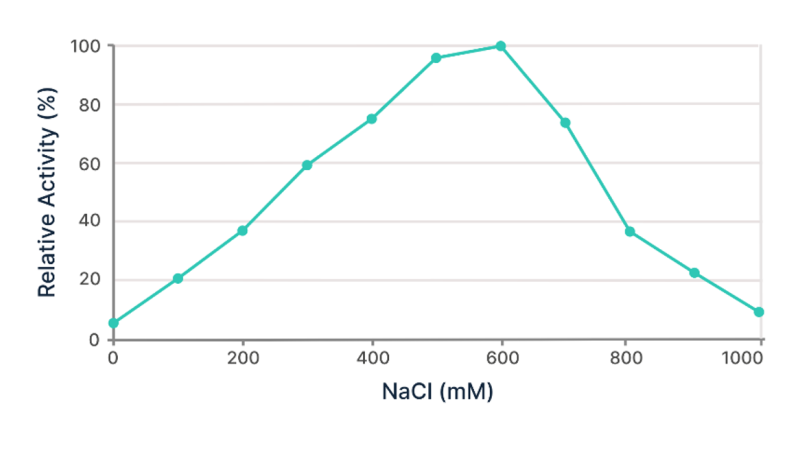
HL-SAN has optimum activity between 400 - 700 mM NaCl but can be used in a broad range of NaCl-concentrations. The activity was measured at 37°C in a 25 mM Tris-HCl buffer, pH 8.5, 5 mM MgCl2 with varying concentrations of NaCl. Maximum activity was set to 100%. Similar results were obtained using KCl instead of NaCl (results not shown).
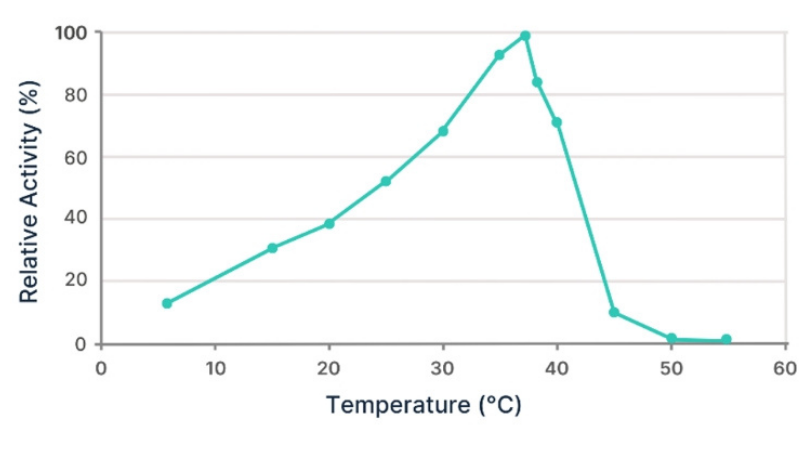
HL-SAN originates from a cold-adapted organism, which allows excellent performance at the temperature ranges commonly used in bioprocessing. For temperature sensitive products, DNA digestion overnight at 4°C is also possible. The activity was measured in a 25 mM Tris-HCl buffer at pH 8.5 (@ measurement temperature), 5 mM MgCl2 and 500 mM NaCl. 37°C was set to 100%.

Fig 3. The effect of MgCl2 and MnCl2 concentration on the HL-SAN activity.
The activity of HL-SAN was tested in a 25 mM Tris-HCl buffer, pH 8.5, 0.5 M NaCl and with varying concentrations of MgCl2 or MnCl2. The activity of the sample containing 5 mM MgCl2 was set to 100%.
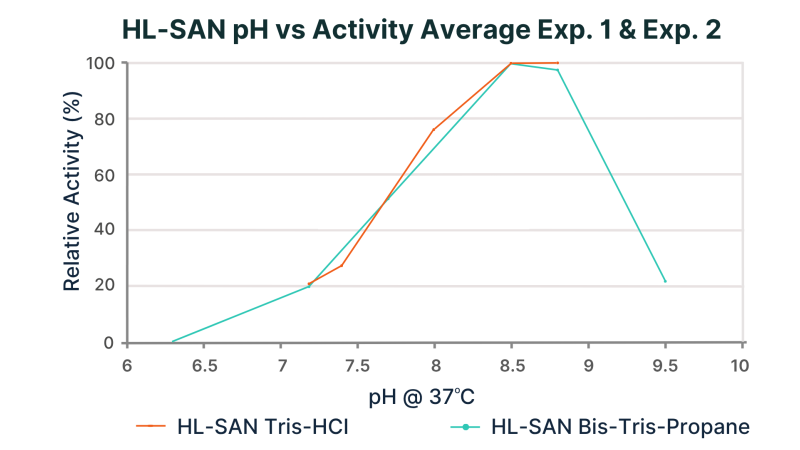
HL-SAN performs best in the 8.0 - 8.8 pH range. A working range starting at pH 7.0 allows use in most biological buffers. The activity was measured at 37°C in a 25 mM Tris-HCl or Bis-Tris Propane buffer buffer at various pH, 5 mM MgCl2 and 500 mM NaCl. Maximum activity was set to 100%.
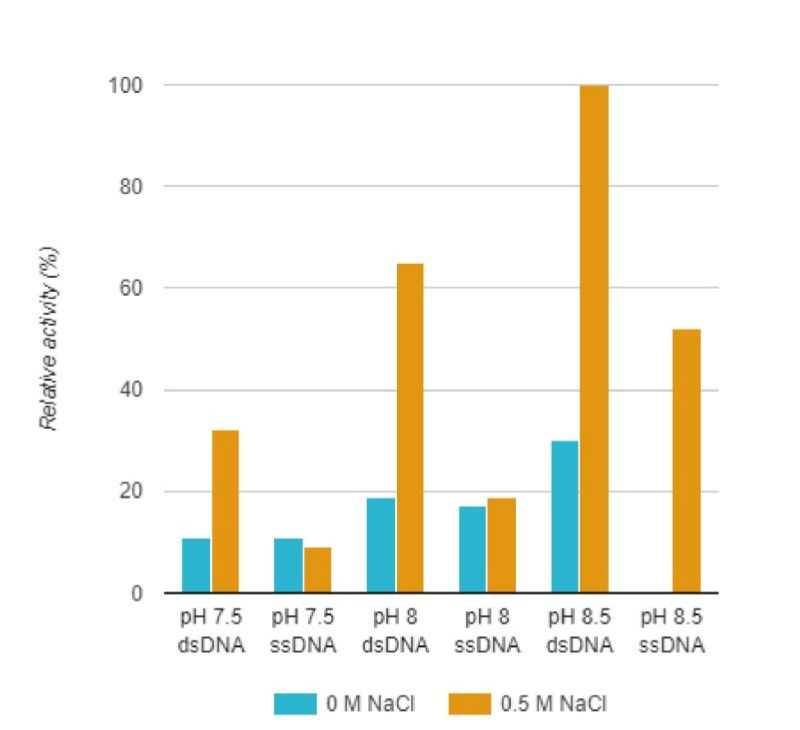
Without NaCl, the specificity towards ssDNA and dsDNA is similar. At 0.5 M NaCl, the activity towards dsDNA increases, while the activity towards ssDNA is unaffected.

The size of the end products from ssDNA varies from ~5-13 nt, while dsDNA is digested to around ~5-7 nt. The size of the end products seems to depend on the DNA sequence. Substrates 1 and 2 were ssDNA with different sequences and substrates 3 and 4 were dsDNA with similar sequences but with a FAM-label at different ends. Substrate 5 was dsDNA with the same sequence as substrate 3 and 4 but with a FAM-label at both ends.

The activity of HL-SAN was tested in a 25 mM Tris-HCl buffer, pH 8.5, 5 mM MgCl2, 0.5 M NaCl and with increasing concentrations of glycerol. The activity of the control not containing glycerol was set to 100%.

The activity of HL-SAN was tested in a 25 mM Tris-HCl buffer, pH 8.5, 5 mM MgCl2, 0.5 M NaCl and with varying concentrations of imidazole. The activity of the control not containing imidazole was set to 100%.
Properties
.
Recommended Protocols
Ordering Info

Product update:
HL-SAN formulations containing Triton (previously sold under product codes 70910-202 and 70910-150) are being phased out as part of our transition to Triton-free solutions. Triton-free HL-SAN formulations are available above, or contact our team to discuss your workflow or request a quote.

 Powered by Bioz


