
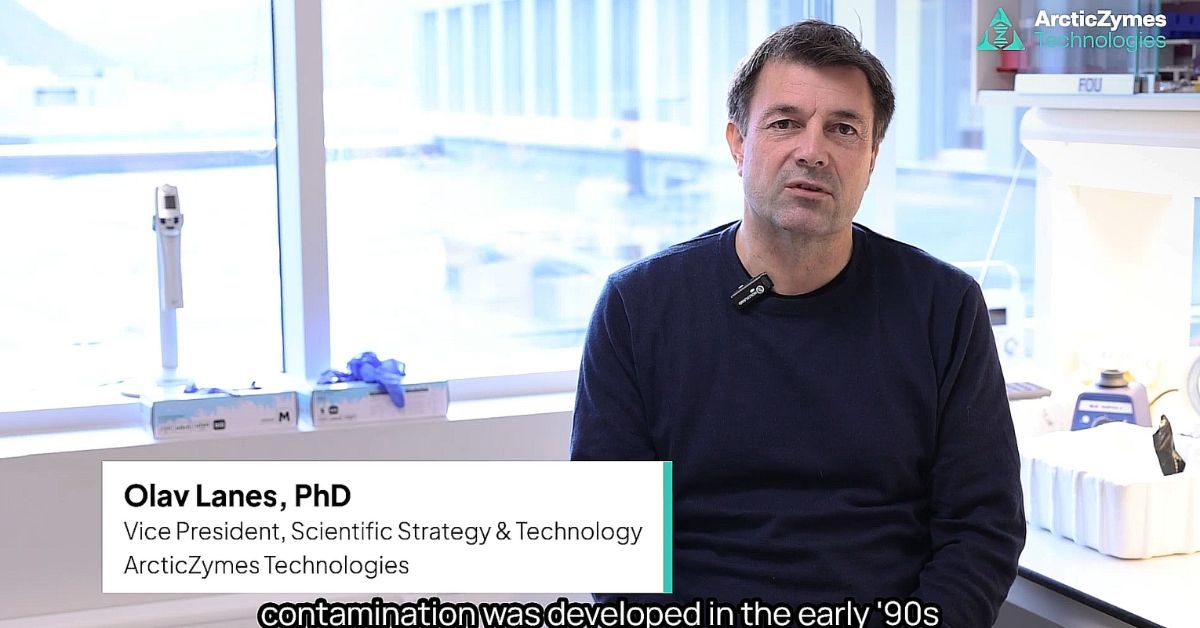

Explore the story behind Cod UNG and the development of the original heat-labile uracil-DNA glycosylase (UDG). Developed as a solution for DNA carry-over contamination, Cod UNG combines effective uracil-DNA excision with the advantages of a heat-labile enzyme. This video looks back at the science behind its discovery, the search for cold-adapted enzymes and how that work contributed to the development of Cod UNG at ArcticZymes.
Watch the video to learn more about the origins and science behind Cod UNG.
Transcript
Carryover containment problem
The technology of enzymatic prevention of carryover contamination was developed in the early '90s using an UDG enzyme in PCR technology. The main problem with the technology was that the enzyme available at the time was not possible to heat inactivate, and that led to the degradation of the PCR product, resulting in a loss of sensitivity and also the potential risk of not picking up a positive signal at all in the diagnostic assay.
In addition, no enzyme existed that was compatible with the RT-PCR technology, where inactivation of the enzyme at 50 degrees is critical to get the assay to work, and this prevented the use of the technology for a broader range of tests such as RNA viruses. This was the challenge that we set out to solve.
The origin
ArcticZymes is a company specializing in novel enzymes for research diagnostics and biomanufacturing, and it's located in Tromsø, northern part of Norway, just north of the Arctic Circle. The origin of the company goes back to the mid-'90s and is originally a spin-out from university research. The first product of the company was shrimp alkaline phosphatase, which was developed and commercialized in the mid-'90s.
Cold-adapted enzymes
At the University of Tromsø, there has been a lot of research on the Arctic marine diversity and how the organism can be adapted to sustain life at cold temperatures. In addition to studying the molecular adaptation of the enzymes to be able to catalyze reactions even at temperatures down to zero degree Celsius.
Enzymes from such cold-adapted organisms are often recognized to have very high activity, up to around thirty-seven degrees, and if you heat them over fifty degrees Celsius, often the structure collapse and enzyme activity dies off, providing a very convenient off button if you are to employ the enzyme in molecular workflows.
And this is how we have been able to solve our specific challenge in diagnostics.
Searching for a heat-labile UDG
So there was a need for a heat-labile UDG, and the company initiated a collaboration project together with the University of Tromsø to find such a enzyme. And I started in a PhD project in order to isolate and characterize such a enzyme. I started purifying it from cod liver because that was a easily accessible material in northern part of Norway, and we knew that the enzyme existed in cod liver.
It was quite challenging because very little enzyme exists naturally in cod liver, but I was able to purify sufficiently to characterize the enzyme and verify that it had the right properties and was heat-labile. However, in order to further study the enzyme and lay the groundwork for a commercial product, we had to isolate the gene and go for a recombinant production of the enzyme.
So my father and I, we went out on a fishing trip in our family boat and went just outside of Tromsø, where we were equipped with liquid nitrogen, fished a cod, took some liver samples, and took that back to the lab. And from that material, the gene was isolated and cloned into a expression vector, transformed into E. Coli.
And I still remember the late Friday when I went into the room where the assay result came out verifying the successful expression of the enzyme in E. coli, active and in quite good yield. So the yield was good, but it had to be further optimized and I did that during my PhD as well as developing the downstream chromatography process in order to make the protein or enzyme completely pure, a quite extensive biochemical characterization, and later on the structure was also solved.
From Discovery to Diagnostics
The PhD laid the foundation for introducing the Cod UNG to the market in 2003, and this allowed greater sensitivity in diagnostic assays while reducing the risk of false positives. This helped PCR to be a efficient tool for pathogen detection and faster and more precise diagnostic, impacting patient outcomes.
The enzyme was incorporated in many diagnostic tests like HIV detection and viral load tests, and used in a lot of PCR tests during the Corona pandemic. While qPCR and closed tubes reduce the risk of cross-contamination, the impact of false positives is still high and very difficult to get rid of if first gotten into the lab.
So the Cod UNG technology is still cost efficient and simple insurance avoiding the problem of carry-over contamination in diagnostics.


