

Gene therapies are rewriting what “treatable” means. Across adeno-associated virus (AAV) and lentiviral (LV) pipelines, one-time treatments now promise durable, sometimes curative outcomes previously untreatable diseases. Yet these therapies are also among the most expensive medicines ever launched. Today, AAV therapies typically cost $850,000 to $3.5 million per patient, while LV-based therapies are often in the $3–4 million range. The science has largely arrived. The economics have not.
Why gene therapy is so expensive
Viral vector manufacturing costs remain a major barrier to scalability and patient access. Much of the cost is not inherent to the biology, but driven by inefficiencies in manufacturing — particularly downstream processing, where yield losses and purification challenges directly impact cost of goods (COGS).
What drives viral vector manufacturing costs
As a 2025 review put it bluntly, legacy manufacturing processes remain “the leading driver of high therapeutic costs” in cell and gene therapy.[1] If we want these therapies to reach more than a fortunate few, the conversation has to move from the lab bench to the production suite.
Why downstream processing (DSP) is the bottleneck
Viral vectors are among the most complex biologics ever commercialized — produced by living cells, assembled correctly, then purified without being destroyed. The result is a process that is often low-yield, highly variable and prone to failure.[2] The substantial cost of goods (COGS) for vector production “acts as a major impediment to widespread gene therapy accessibility,” driven by intricate processes, low titres and expensive purification.[3]
The pinch point is downstream processing (DSP). Broadening gene therapies beyond ultra-rare indications demands higher yields and lower COGS, yet DSP remains un-standardized and difficult to optimize across the industry.[4] Every percentage point of vector lost during purification is paid for twice — once in wasted upstream material, and again in the larger batches needed to compensate.
The speed-to-market tax
Cost and speed are the same problem wearing different clothes. Systemic AAV therapies can require doses as high as 1×10¹⁴ vector genomes per patient, meaning a single 2,000 L bioreactor run may treat less than 100 patients.[5] Demand routinely outstrips supply, leaving developers facing 18–24 month waits for a manufacturing slot.[5]
When yield is low and recovery unpredictable, timelines stretch, capital sits idle, and the patients waiting at the end of the queue wait longer. Improving recovery isn’t only a cost lever — it is a speed lever.
How chromatin impacts viral vector manufacturing
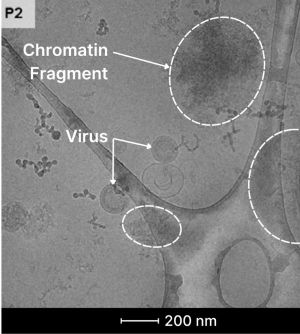
Most optimization effort goes upstream, into titre. But a quieter problem sits downstream: chromatin. When host cells are stressed to maximize vector output, they die and release DNA — not as tidy “naked” strands, but as dense, bulky chromatin.
Why chromatin is difficult to remove?
Because of its size and charge, chromatin clogs purification filters, reduces chromatography performance and drags down recovery.[6]
Limitations of conventional nucleases in DSP
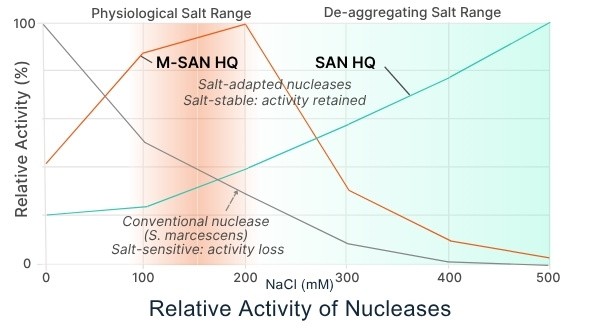
Conventional endonucleases derived from Serratia marcescens were never designed for this. Their activity can drop by nearly half under the physiological salt conditions found in cell media, leaving chromatin only partially fragmented.[6]
Peer-reviewed work shows the residual material survives even comprehensive purification: chromatin fragments larger than the virus-like particles themselves have been detected in supposedly purified product.[6,7]
In other words, the contaminant the industry assumed it had removed is often still there — quietly compounding cost.
How to reduce viral vector manufacturing costs
The role of nuclease strategy in downstream processing
ArcticZymes’ viral vector manufacturing cost model quantifies what fixing this is worth. Built on experimentally validated AAV and LV workflows, it compares nuclease strategies under real process conditions rather than predicting absolute prices.[8]
Advantages of salt-active nucleases in viral vector production
Adopting salt-active nucleases — enzymes that fully digest chromatin at the salt levels actually used in bioprocessing — delivers:
- ~2× improvement in overall process recovery
- More than 70% reduction in nuclease-related cost per batch
- An estimated 40% reduction in cost of goods per dose [8]
Those gains come from a single, well-placed change. M-SAN HQ clears chromatin at physiological salt — critical for fragile vectors like lentivirus — while SAN HQ handles high-salt AAV and adenovirus processes.[6]
Remove the worst contaminant before DSP even begins, and yield, purity and throughput all improve together.
Impact on cost of goods (COGS) and scalability
The strategic point is bigger than one enzyme. The fastest route to affordable, accessible gene therapies is to de-risk the process, not just the molecule:
- Optimize DSP early — recovery decisions set the cost ceiling
- Target high-leverage, low-risk steps first
- Build robustness, not just yield
- Treat process decisions as commercial decisions. As ArcticZymes CEO Michael B. Akoh notes, nuclease strategy is “not a minor technical detail, but a strategic decision that can meaningfully improve affordability and access”.[8]
How to optimize DSP for scalable gene therapy manufacturing
Affordability is not a downstream consequence of access — it is access. Every point of recovery recovered, every batch made cheaper and more reliable, lowers the price floor and shortens the queue.
The biology already works. Making the manufacturing work just as hard is how these therapies finally reach the patients who need them.
References
- 2025 cell and gene challenges:Scalability, supply chain and manufacturing — Cell & Gene Therapy Review (2025).
- CDMO Viral Vector Manufacturing Bottlenecks & Scale-Up —CDMO World (2025).
- Thompson, A. L. Viral Vector Manufacturing: Hurdles to GeneTherapy Success. J. Bioprocess. Biotech. 15:688 (2025).
- Viral-vector therapies at scale: Today’s challenges and future opportunities — McKinsey Company (2022).
- CDMO World (2025), citing ASGCT 2023 and BioProcessInternational 2024 — see [2].
- Efficient Chromatin Removal in Viral Vector ManufacturingUsing Salt-Active Nucleases — ArcticZymes Technologies white paper, v1.3.1(2025).
- Pereira Aguilar, P. et al. J. Chromatogr. A 1627,461378 (2020); Mayer, V. et al. Biotechnol. Prog. 39, e3342 (2023); Pagallies,F. et al. Vaccine X 18, 100474 (2024)
- ArcticZymes Releases New White Paper Quantifyingthe Impact of Optimized Nuclease Strategy on Viral Vector ManufacturingEconomics (26 Feb 2026)


