

Application Overview
One-step RT-qPCR is widely used in molecular diagnostics, but effective carry-over contamination control was historically difficult because conventional UDGs remain active during reverse transcription and can degrade newly synthesized cDNA.
The introduction of heat-labile Cod UNG transformed this workflow by eliminating carry-over contamination while becoming inactive before reverse transcription begins, enabling robust contamination control without compromising assay sensitivity
Application Overview
One-step RT-qPCR is widely used in molecular diagnostics, but effective carry-over contamination control was historically difficult because conventional UDGs remain active during reverse transcription and can degrade newly synthesized cDNA.
The introduction of heat-labile Cod UNG transformed this workflow by eliminating carry-over contamination while becoming inactive before reverse transcription begins, enabling robust contamination control without compromising assay sensitivity
The Challenges These Enzymes Address
Carry-over contamination in one-step RT-qPCR
Carry-over contamination from previous PCR reactions can generate false positives and compromise confidence in assay performance, triggering repeat testing, investigations, and delays. Robust contamination control is both a regulatory expectation and a practical necessity in one-step RT-qPCR workflows.
A conventional UDG cannot safely be used here
Conventional E. coli UNG remains active at temperatures used during reverse transcription (typically 45–55°C), degrading newly synthesised cDNA as fast as it's made. What's needed is an enzyme that can remove contaminating amplicons at low temperature, rendering it inactive once reverse transcription begins.
Sample matrix can interfere with contamination control
Direct-sample workflows — running RT-qPCR straight from serum, plasma, or whole blood without an upstream RNA extraction step — reduce hands-on time and remove a common assay-development bottleneck, but they also expose every reagent in the reaction, including the enzyme handling carry-over control, to whatever inhibitors are present in the raw sample.
One-Step RT-qPCR: one enzyme,every stage
THE PROBLEM These ENZYME SOLVES
Carry-over contamination in one-step RT-qPCR
Carry-over contamination from previous PCR reactions can generate false positives and compromise confidence in assay performance, triggering repeat testing, investigations, and delays. Robust contamination control is both a regulatory expectation and a practical necessity in one-step RT-qPCR workflows.
A conventional UDG cannot safely be used here
Conventional E. coli UNG remains active at temperatures used during reverse transcription (typically 45–55°C), degrading newly synthesised cDNA as fast as it's made. What's needed is an enzyme that can remove contaminating amplicons at low temperature, rendering it inactive once reverse transcription begins.
Sample matrix can interfere with contamination control
Direct-sample workflows — running RT-qPCR straight from serum, plasma, or whole blood without an upstream RNA extraction step — reduce hands-on time and remove a common assay-development bottleneck, but they also expose every reagent in the reaction, including the enzyme handling carry-over control, to whatever inhibitors are present in the raw sample.
One-Step RT-qPCR: one enzyme,every stage
THE PROBLEM These ENZYMes SOLVE
Carry-over contamination in one-step RT-qPCR
Carry-over contamination from previous PCR reactions can generate false positives and compromise confidence in assay performance, triggering repeat testing, investigations, and delays. Robust contamination control is both a regulatory expectation and a practical necessity in one-step RT-qPCR workflows.
A conventional UDG cannot safely be used here
Conventional E. coli UNG remains active at temperatures used during reverse transcription (typically 45–55°C), degrading newly synthesised cDNA as fast as it's made. What's needed is an enzyme that can remove contaminating amplicons at low temperature, rendering it inactive once reverse transcription begins.
Sample matrix can interfere with contamination control
Direct-sample workflows — running RT-qPCR straight from serum, plasma, or whole blood without an upstream RNA extraction step — reduce hands-on time and remove a common assay-development bottleneck, but they also expose every reagent in the reaction, including the enzyme handling carry-over control, to whatever inhibitors are present in the raw sample.
One-Step RT-qPCR: one enzyme,every stage
The Solution
Cod UNG is highly active from room temperature up to 37°C, efficiently removing uracil-containing carry-over contamination during this setup phase. Reverse transcription should run at a temperature with sufficient margin above this range — 50°C is well validated in practice, though lower temperatures may also work. This is the key difference from conventional E. coli UNG, which typically remains active well into the reverse transcription range regardless of kit design.


Cod UNG remains inactive where competing cold-adapted UDGs do not
Other commercially available cold-adapted UDGs can fail to lose activity fully at the temperatures reverse transcription runs at, leading to loss of cDNA and compromised reaction integrity (figure 3).
Activity is maintained in clinical sample matrices
Cod UNG tolerates blood components including serum and the anti-coagulants EDTA and Na-heparin, so carry-over control does not add a new failure point for developers building extraction-free assays (figure 4) enabling seamless kit integration.


Amplicon storage & downstream use
Some RT-qPCR workflows — diagnostic and public-health surveillance in particular — need to return to positive sample tubes after the initial result, for example to sequence viral RNA and track variants. This depends on the amplified product still being intact, not just on the original result being accurate.
Cod UNG supports this: once the reaction has reached approximately 55°C, it is completely and irreversibly inactivated, so it cannot degrade product afterwards, whether that product is used immediately or stored first.
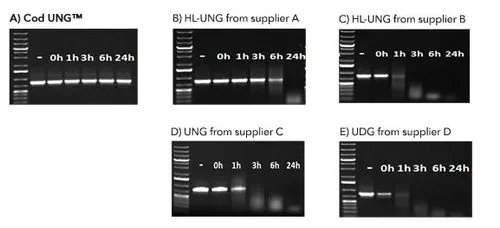
PCR was performed with dUTP and one of five commercially available UDGs. Post-PCR, the products were incubated at room temperature for various intervals, then heated and cooled. Gel electrophoresis showed reactivation and severe product degradation with every UDG tested except Cod UNG.
Contamination control in one-step RT-qPCR
Be sure that you have used dUTP containing dNTP mixes in your previous PCR experiments.
Two options depending on your workflow:
- Add Cod UNG and incubate, two options depending on workflow:
- Add Cod UNG to a final concentration of 0.01 U/µl, with a 5-minute pre-incubation at 25°C prior to RT-qPCR.
- Add Cod UNG to a final concentration of 0.04 U/µl, with no pre-incubation step.
- Reverse transcribe your RNA at 50-55°C.
- Run your PCR.
- Store your PCR product at -20°C or 4°C degrees.
This protocol is a recommended starting point for evaluation and optimisation. Reaction conditions may need adjustment depending on your specific assay, sample type, and equipment. We are happy to help you optimize Cod UNG in your assay, speak to our Cod UNG experts.
Application Background
The dUTP/UDG carry-over prevention system, introduced by Longo and colleagues in 1990, is the standard approach across PCR-based assays. It works because PCR's repeated high-temperature denaturation step eventually inactivates a conventional UDG. One-step RT-qPCR breaks this: dUTP has to be present in the master mix from the start, before reverse transcription even begins, and RT has no denaturation step to inactivate the enzyme before cDNA synthesis is complete. Cod UNG's low-temperature activity and loss of activity before significant cDNA has formed close that gap, making it the gold standard for carry-over control in one-step, closed-tube diagnostic formats.
Manufacturing you can trust
Cod UNG has been supplied to diagnostic kit manufacturers for over two decades. Manufactured under ISO 13485, it offers the consistent quality and supply that regulated workflows depend on — contamination control that doesn't compromise sensitivity or performance, enabling robust assay development. Further details on manufacturing, specifications, and supply are available on the Cod UNG .
